
Real objects, real reasoning
Each unit centers on an actual invention — how it worked, why it appeared when it did, and what problem it genuinely solved.
A course that treats invention as a chain reaction — each breakthrough traced back to the problem it solved, and forward to the technology students carry in their pocket today.
Dates fade. The reason someone needed a printing press, or why a steam engine reorganized a whole century, doesn't.
Each unit centers on an actual invention — how it worked, why it appeared when it did, and what problem it genuinely solved.
Every invention traces back to the one before it and forward to the one it made possible — a chain, not a list of facts.
Students build simplified working models of key inventions — a lever, a simple circuit, a pulley — to see the mechanism, not just read about it.
Every unit ends by connecting the invention to something the student actually uses now — the course closes the loop every time.
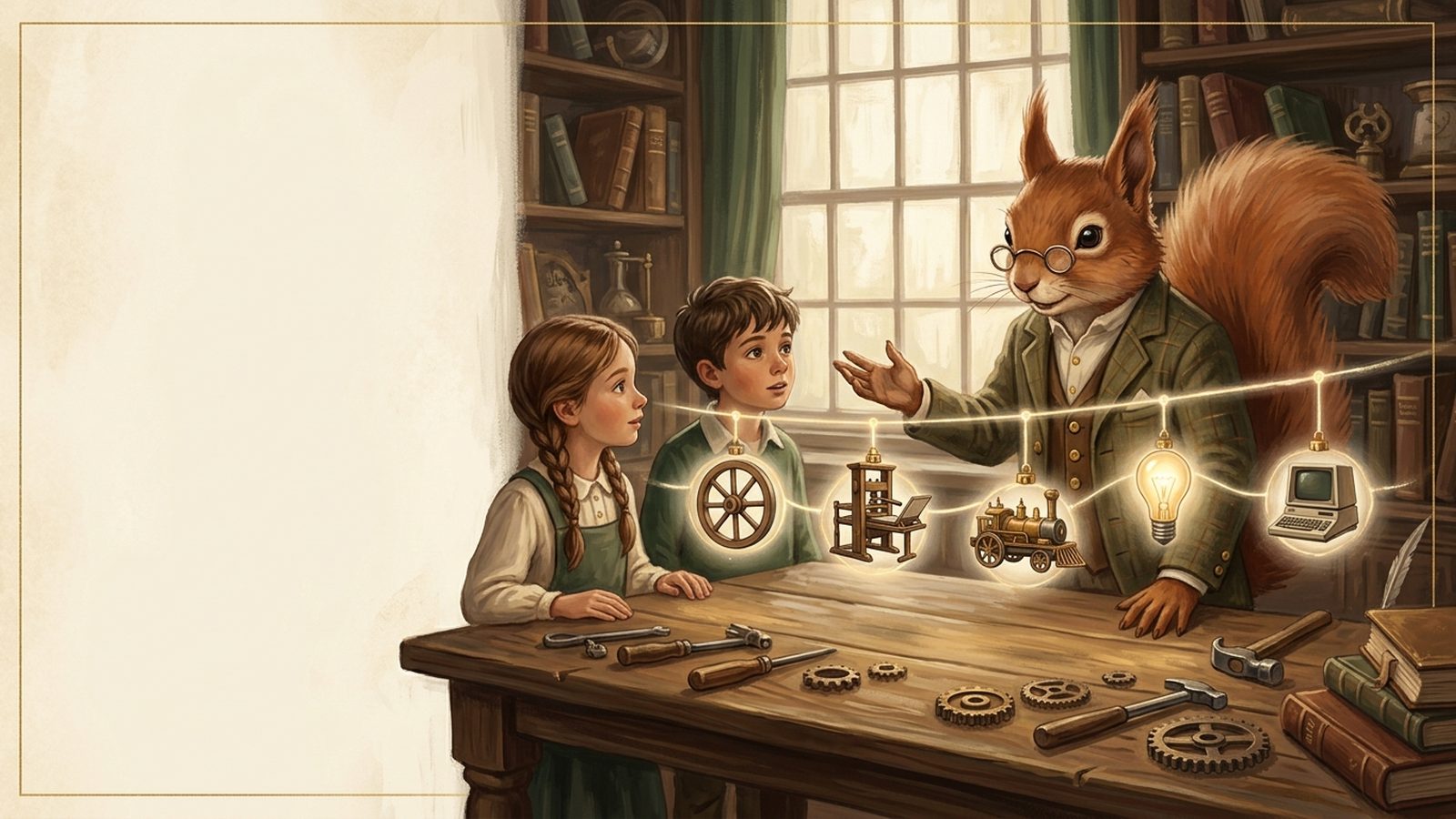
The course moves in the same order the world did — simple mechanical tools first, then the industrial machines that reorganized whole societies, ending at the electronics running the school's own computers.
Each session pairs a real historical case with a small hands-on build — a lever, a simple circuit, a working pulley — so the mechanism is something a student can touch, not just read about.
The final project asks each student to pick one invention and explain, in their own words, why it mattered — not just what it was.
The goal isn't a list of dates — it's the habit of asking why something changed, and what changed because of it.
Can say what problem an invention solved and why it appeared at that moment — not just recite a date.
Follows a line from one invention to the next across centuries — cause to effect, not isolated facts.
Has physically built a simplified version of at least one historical mechanism, not just read a description of it.
Draws a direct, specific line from a historical invention to a piece of technology used today.
Every unit ends the same way — a real invention, connected all the way to today.